


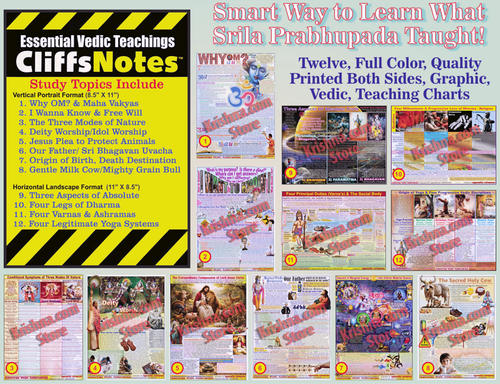
Both sides of each chart are printed in full color on firm 100 # durable gloss paper.
- Each chart is developed directly from the text given in the sacred Vedic literature.
- Charts are printed on both sides using high quality gloss paper in full color.
- Key concepts related to each topic are presented with supporting scriptural citations.
- These highly condensed notes summarize Vedic teachings spread over hundreds of pages of material.
This colorful, highly illustrated collection of core Vedic teachings is ideal for studying with a small child learning to read. A parent can have quality bonding time planting the seed of Vedic knowledge while helping them learn how to read English!
**Bonus: Sheet of 30 Transcendental Stickers**
1. Why Om? & Maha Vakyas
Chanting Om has become popular within many spiritual organizations, but try asking those who lead those Om sessions: “Why do you chant OM?”You would be surprised at what type of answers you would get. This chart nicely explains the answer to that question. The back-side addresses another phenomena that is popular among the same groups that often quote one of the five popular Maha-Vakyas like “Tat-Tvam-Asmi”. This chart reviews these expressions from the Upanishads and provides a clear way to understand them.
2. I Want to Know & Free Will
At some point people ask: “Is there a God & Why am I here.” This chart provides the road map illustrating the two most frequent ways people answer to these perennial questions. 1) Theologically or 2) Scientifically. It then tracks the consequences of those choices. Another point of uncertainty many are uncertain about is: “Free will”. .Some are not clear if they even have free will. On the back of this chart, both alternatives are mapped out. We see what occurs to those who use their free will properly and what occurs for those who fail to do so.
3. Three Modes of Material Nature
This provides a comprehensive check list that identifies which modes of nature your habits reflect. This is great for mapping how someone’s strengths and weaknesses are impacted by the modes of Goodness, Passion, & Ignorance. Much of this material has been lifted directly from chapter 14 of the Bhagavad Gita and other supporting resources like the Srimad Bhagavan.
4. Difference Between Deity Worship & Idol Worship
Devotees understand the importance of Deity worship but the Abrahamic faiths mistake that with Idol worship. This chart addresses the difference between the lust for chasing whimsical idols and the importance of proper Deity worship that trains us to remember and engage in our eternal relationship with the Supreme Lord.
5. Jesus’s Compassionate Plea To Protect the Animals
The Bible can be used to justify or abstain from eating animals. On the front of this chart Biblical references are given to illustrate the compassion of Jesus’s appeal to not eat the innocent animals. On the back secular reasons are given why it is beneficial to be a vegetarian for environmental and health benefits.
6. Our Father / Vedas Compared to the Bible
It is astonishing how many Christians do not even know the history of their own Bible which has migrated thru numerous languages and political influences. It compares that history to how the Vedas have been handed down via the parampara and has remained unchanged over thousands of years. Several other important philosophical differences are also laid out for comparative studies.
7. Origin: Birth & Death of the Body
This is a very detailed chart that illustrates how the spirit soul falls away from the spiritual world as soon as the ego begins to manifest. It maps the way it descends into the material world and takes its place among the 8,400,000 different species of life. On the back it shows the various ways the soul will reincarnate depending on the consciousness it has at the end of life.
8. Gentle Milk Giving Cow & Mighty Grain Giving Bull
People in the West generally have no idea why the cow and bull are considered sacred in Vedic culture. This chart explains why these extraordinary animals are so important in developing a healthy, spiritually progressive civilization.
9. Three Aspects of Absolute Truth
This elaborates on the three different ways Krishna manifests in the form of Brahman, Paramatma, & Bhagavan. (SB. 1.2.11) It shows how the Christian concept of the Trinity fits into these various expressions of the Supreme Lord and it provides the parameters that define each different aspect.
10. Four Legs of Dharma/Duty
Religion is upheld by the four principles of freedom: 1)Austerity 2)Cleanliness 3)Mercy & 4)Truthfulness. This chart illustrates how each one of these qualities deteriorate consecutively as the chatur-yuga cycle moves forward in time. It also identifies the various secular attempts implemented to preserve these qualities and why they cannot work. It then lists the ways these principles are naturally preserved by implementing Vedic culture.
11. Four Ashrams, Four Varna
The varna/ashrama system is the natural way to divide and regulate the functional branches of society. This chart identifies, integrates and explains each of those eight distinct branches using easy language and graphics. In this way even a simple layman can understand how Vedic society is structured for the benefit and prosperity of all.
12. Four Legitimate Yoga Systems
Yoga has become so popular it has expanded into a plethora of commercially fabricated so-called new “yoga” techniques. This has perverted the four tier progressive yoga ladder which was created specifically for the purpose of lifting the conditioned soul up in consciousness. It illustrates how karma yoga is the beginning point in this process which culminated with the adoption of bhakti yoga.


